
Steiner and an Eclipse
by David Ovason (publ. in New View 1999)

It is likely that the greatest personal tragedy that befell Steiner was the burning down of the first Goetheanum on the last day of 1922. [This was a large wooden structure with two great domes, which Steiner designed and built, with help from people from many countries. Its replacement (also designed by Steiner but completed after his death) can be seen today at Dornach in Switzerland.] I would like to consider this disaster from the point of view of Steiner himself in terms of his personal horoscope. I do not propose to examine Steiner’s horoscope in any depth, or in a way which will be impenetrable for the non-astrologer. I shall restrict my interest to a single solar eclipse which left a mark on Steiner’s life.
Eclipse lore is widely not studied in modern times. Because of this, before examining the effect of an eclipse in the horoscope of Steiner, I should set down the basic rule of this lore. According to the ancient tradition, an eclipse can influence the life of an individual only when it falls upon a sensitive point in the birthchart of that individual. This explains why the eclipse of August 1999 will have no effect on the lives of the majority of people. The eclipse falls in 18.21 degrees of zodiacal Leo, and relatively few people have this degree emphatic in their personal charts. Only those with this degree occupied by a planet, a lunar node, or one of the four angles is likely to feel the influence of the eclipse in their lives.
By definition, an eclipse takes place in a specific degree of the zodiac. From an astrological point of view, it is this degree which is important, and which (so to speak) throws the influence of that eclipse into the cosmos. The effect of the eclipse hovers in the cosmos for a short time, where it remains as a sensitive point, fixed in the specific degree of the zodiacal circle where the eclipse took place. It is as though each eclipse (whether lunar or solar) burns a hole into the degree where it took place, leaving that part of the zodiac sensitive to other influences.
This sensitive mark in the Macrocosm may at times find a corresponding sensitive degree in the horoscope of the Microcosm, which is the human being. In terms of eclipse-lore, any person who has 18.21 degrees of Leo emphasised in their chart is likely to see some fundamental change in their life as a consequence of the eclipse of August 1999.
When the sensitive degree of an eclipse corresponds exactly with a degree in a personal horoscope, then unexpected cosmic influences pour into the life of the individual concerned. These influences can be beneficial or deleterious, depending upon the nature of the basic horoscope. Clearly, this part of eclipse-lore is rooted in the notion that something of great significance must occur when the shadow-tunnel in the cosmos corresponds to a degree in a personal chart.
In my recent study, The Book of the Eclipse, there are many interesting case histories which illustrate how, when eclipses find correspondences in personal charts, unexpected benefits or losses pour into the lives of certain individuals. For example, I show how the music of Mozart and Beethoven was influenced by eclipses; how the personal trials of such men as Ralph Waldo Emerson and President Clinton were reflected in eclipses; how the publication of literary works by such writers as Beatrice Potter, Emily Brontë, Hans Christian Andersen and Lord Byron were determined by eclipses; how the tragic ends of such individuals as Robespierre, Marie Antoinette, Adolf Hitler, Marilyn Monroe and Princess Diana were reflected with extraordinary precision in eclipses (there was an eclipse within hours of Diana’s death, in Paris). These people, whatever their personal achievements, may safely be described as having special significance, or importance, within the stream of history.
After examining thousands of charts, I have come to the conclusion that, generally speaking, eclipses have profound influences only on the lives of people who are, in one way or another, important to the stream of history. Why this should be so, I do not know: the more one studies these correspondences, the more one is forced to conclude that the cosmic drama of the eclipse finds an attunement with the personal drama of a historically-important life. Perhaps the eclipse is linked with the creative powers of the spiritual beings, permitting them an opportunity to intervene, even in a dramatic way, in the working of karma on the human plane?
Whatever the spiritual reason behind the personal effects of eclipses, the fact that they seem to work most profoundly in the lives of the historically important, is perhaps one justification for glancing at the effect of a single eclipse on the life of Steiner. Rudolf Steiner was (to my mind) one of the most important of all individuals within the stream of history at the beginning of the twentieth century.
An eclipse can have an effect on a human life only under two circumstances. This is, when the degree in which the eclipse falls corresponds to a degree (or the opposite degree) in the chart of the person concerned. The opposite degree is just as important in eclipse-lore as the specific eclipse degree because an eclipse is the consequence of a shadow-play, an interaction of shadow-tunnels, which relate in every case to an alignment of the three cosmic bodies of Sun, Moon and Earth. Since this triple alignment is thrown directly across the cosmos, it is consequently measured in terms of the two degrees against which the outer of the two bodies are located. For example, a lunar eclipse involves the Sun (measured against one degree) with the Moon measured against its diametrically opposite degree.
A solar or lunar eclipse in (say) Libra, would leave an influence also in the sign Aries, as these two signs are diametrically opposite each other, across the cosmos. For example, the lunar eclipse which will take place on 28 July, 1999 will take place when the Sun is in 05.02 degrees of Leo, and the Moon is in 05.02 degrees of Aquarius. Both these degrees, in Leo and Aquarius, would be regarded as remaining equally sensitive for a few months before and after the actual eclipse.
In 1922 there were two solar eclipses. That which fell on 21 September 1922 was in 27.25 degrees of Virgo. As it happened, this was exactly opposite the degree occupied by the planet Mercury in Steiner’s personal chart. In this horoscope, Mercury was in 27.27 Pisces. In terms of eclipse-lore, this correspondence may be set down as follows:
Mercury in the chart of Steiner: 27.27 PISCES
Solar Eclipse of 21 SEP 1922: 27.25 PISCES
The above data shows the meeting of two sensitive degrees, one being the degree of Steiner’s Mercury, the other that formed by an eclipse. As it happens, even before the eclipse of 1922 reacted with this Mercury, and (as we might surmise) opened it up to the creative play of karma, it was already in a particularly sensitive position in his horoscope. The Mercury of Steiner’s natal chart was within one degree of the planet Neptune (which was in 28.20 Pisces). This means that radical Mercury in his chart was extremely sensitive. For want of a better word, I could say that it was almost mediumistically sensitive.
It was inevitable that when an eclipse fell on the doubly-sensitive Mercury in Steiner’s chart, something of tremendous importance would enter into his life. This event would almost certainly be of profound karmic importance.
Now, the correspondence between an eclipse and an event in the life of a person is exact in space (that is, when measured in the spatial degrees of the zodiacal band) but only approximate in time. Usually, when an eclipse falls on a degree in a personal chart, it manifests through karma within a few months—certainly within six months.
In Steiner’s case, the meeting of the eclipse degree of September 1922 with his natal Mercury, took effect in just over three months. This occured when the Goetheanum burned down, on the New Year’s Eve of that some year. [I have taken the historical background to the burning of the Goetheanum from Guenther Wachsmuth, The Life and Work of Rudolf Steiner, 1955.]
It is highly significant that, while the end of Steiner’s life was troubled by an eclipse, he was also born under the influence of a powerful eclipse. The solar eclipse of 11 January 1861 fell across his lunar nodes (the caput and cauda of traditional astrology):
Caput in the chart of Steiner: 20:22 CAPRICORN
Eclipse of 11 January 1861: 20:58 CAPRICORN
In the traditional eclipse-lore, this is the most powerful axis upon which any eclipse may fall, and it is always involved with genius. In view of this, I do not find it at all surprising that Steiner should have written with such insight on eclipses [L. Kolisko; A. Stifter; R. Steiner, The Sun Eclipse: In scientific experiments & As an experience, Kolisko Archive Publication, 1978.], or that his followers should have found his indications in this cosmic realm to be so fertile.
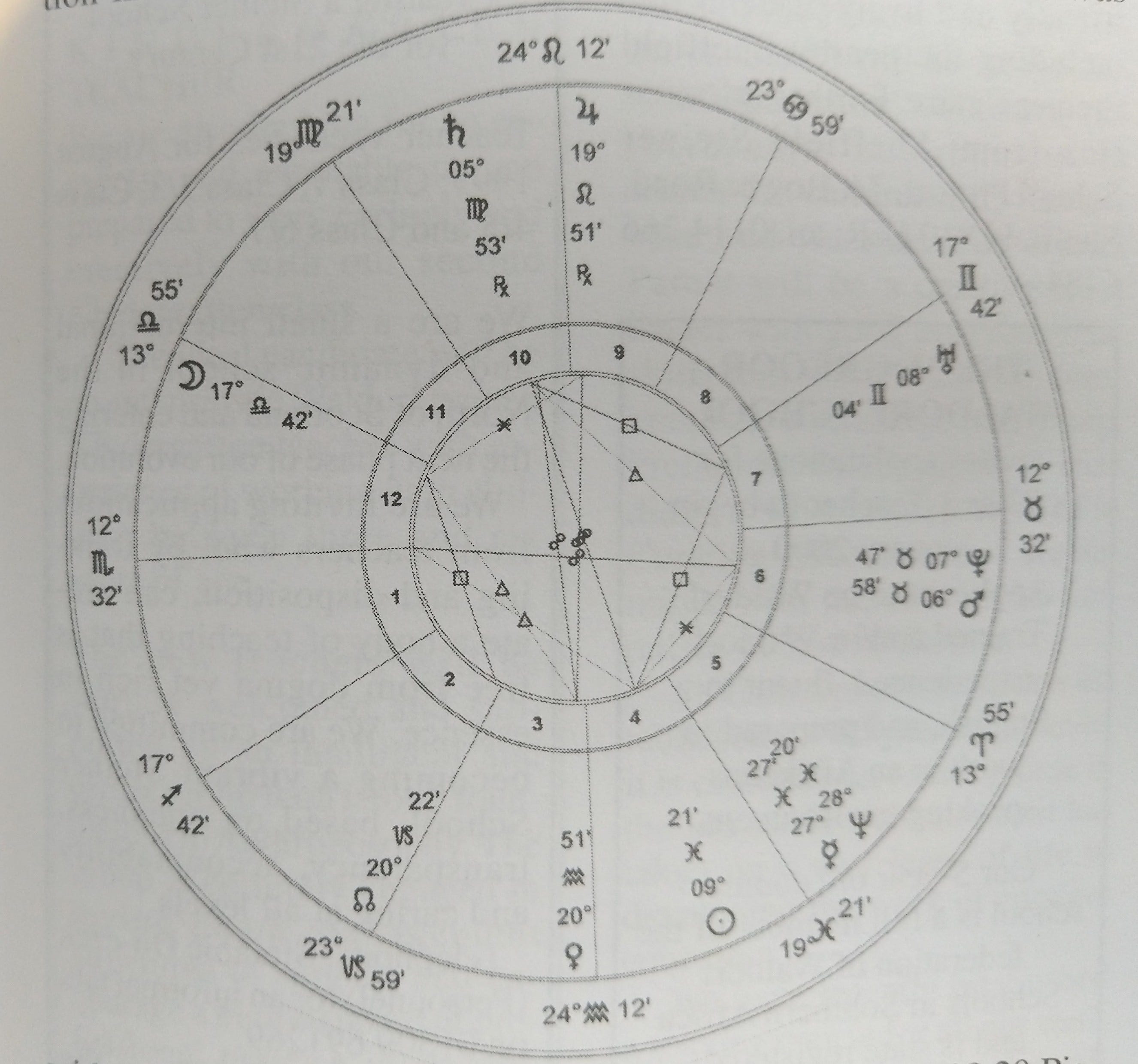
i. I have taken the birth-date from Steiner’s An Autobiography, 1977 edn, p.18. Steiner did not give the time however. I am not convinced of the accuracy of any of the several charts of Steiner which I have seen to date, as it is clear to me that the star Acrux (which in 1861 was in 9.57 Scorpio) must have been on the Ascendant at his birth. However, to avoid possible disputes with astrologers who favour the charts proposed by the Theosophist, Alan Leo, in the early part of this century, I have adopted an Ascendant of 12.32 Scorpio, which corresponds to a local-time birth of 10:17:00 PM.
ii. I have cast the chart for Steiner, for his birth at Kraljevec, 27 February, 1861, preserving a Scorpionic Ascendant. I am aware that there is some dispute as to the precise moment of birth, but the data I give would be accurate to within a minute or two throughout the entire day, and such differences do not in any way call into question the findings I set out above.